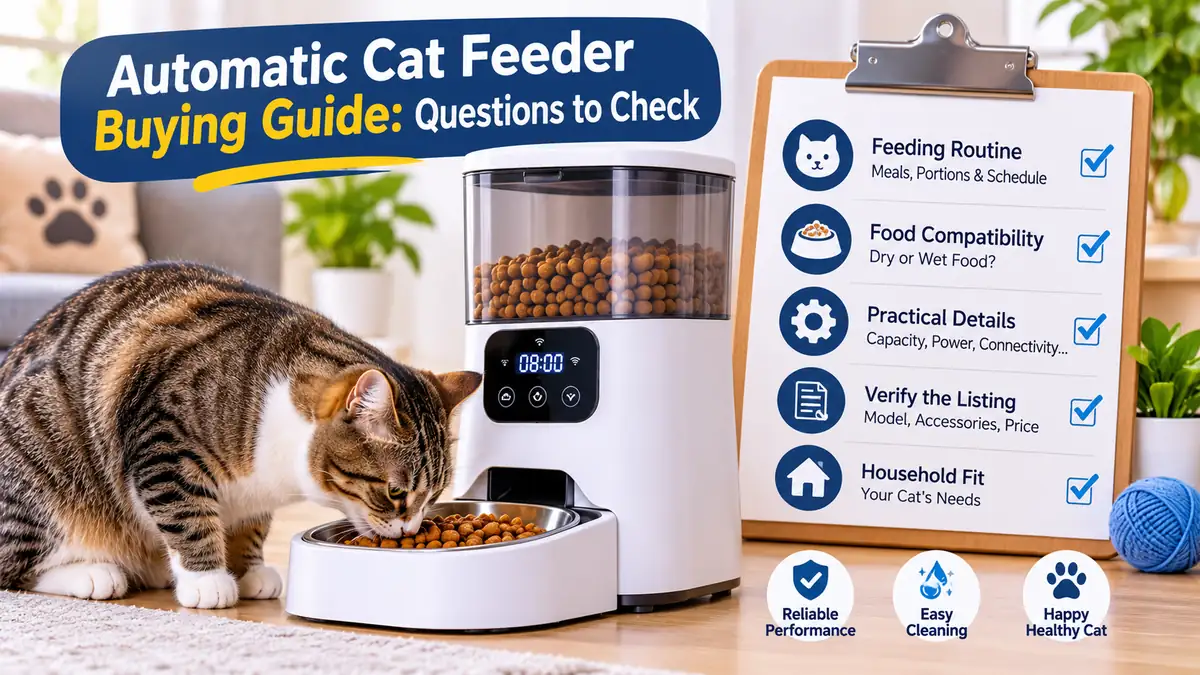
An automatic feeder may help with a household routine, but the product name alone does not tell you whether it fits your cat, food, or schedule. Use this checklist to compare the exact model and variant you plan to buy.
This guide is general buying information, not a hands-on test or veterinary advice. Product details should be confirmed with the manufacturer or seller.
Start with the feeding routine
Write down the food type, the number of meals, and the portions your cat needs. Compare those requirements with the feeder’s documented schedule and portion settings. Do not assume that a stated serving size is accurate for every kibble shape or that a listed capacity tells you how many days the food will last.
For a medical diet, weight plan, or feeding schedule prescribed by a veterinarian, confirm that the device can follow that plan before relying on it.
Check food compatibility
Confirm which food types the specific model supports. A listing that uses phrases such as “wet and dry” is not enough to establish that wet food can be stored safely. Use wet food only when the manufacturer explicitly confirms the intended use and gives safe storage and cleaning instructions.
For dry food, check the permitted kibble size and the dispensing mechanism. A product description does not prove that a feeder will work consistently with every food.
The FDA’s pet-food storage guidance recommends cleaning and drying storage containers between refills and promptly refrigerating or discarding unused canned or pouched food. These are general food-storage recommendations, not a test of an automatic feeder.
Compare the practical details
- Capacity: Compare the stated container size with your household’s routine and how often you can refill it.
- Schedule and portions: Verify the number of meals and portion settings in the manual for the exact model.
- Power: Check whether the feeder needs an outlet, supports batteries, and whether batteries are included. Do not assume a backup battery is present.
- Connectivity: For app features, confirm supported Wi-Fi bands, phone compatibility, and which functions still work without internet.
- Cleaning: Look for removable parts, cleaning instructions, and any parts that must stay dry.
- Reliability: Search for specific reports about jams, missed meals, app failures, and power interruptions. Treat seller ratings as one input, not a guarantee.
- Household fit: Consider whether pets can reach the food, interfere with the feeder, or need separate portions.
Verify the exact listing
Before buying, compare the model name, photos, included accessories, dimensions, return terms, shipping, and final checkout price. Sellers may offer several variants on one page, and the headline may not describe every option. Save or note the specifications you checked because prices and listings can change.
An automatic feeder should support—not replace—observing your cat, providing fresh water, and arranging care when you are away. Test the setup while you are home before depending on it for a scheduled meal.
Product details checked on . Prices and availability can change.